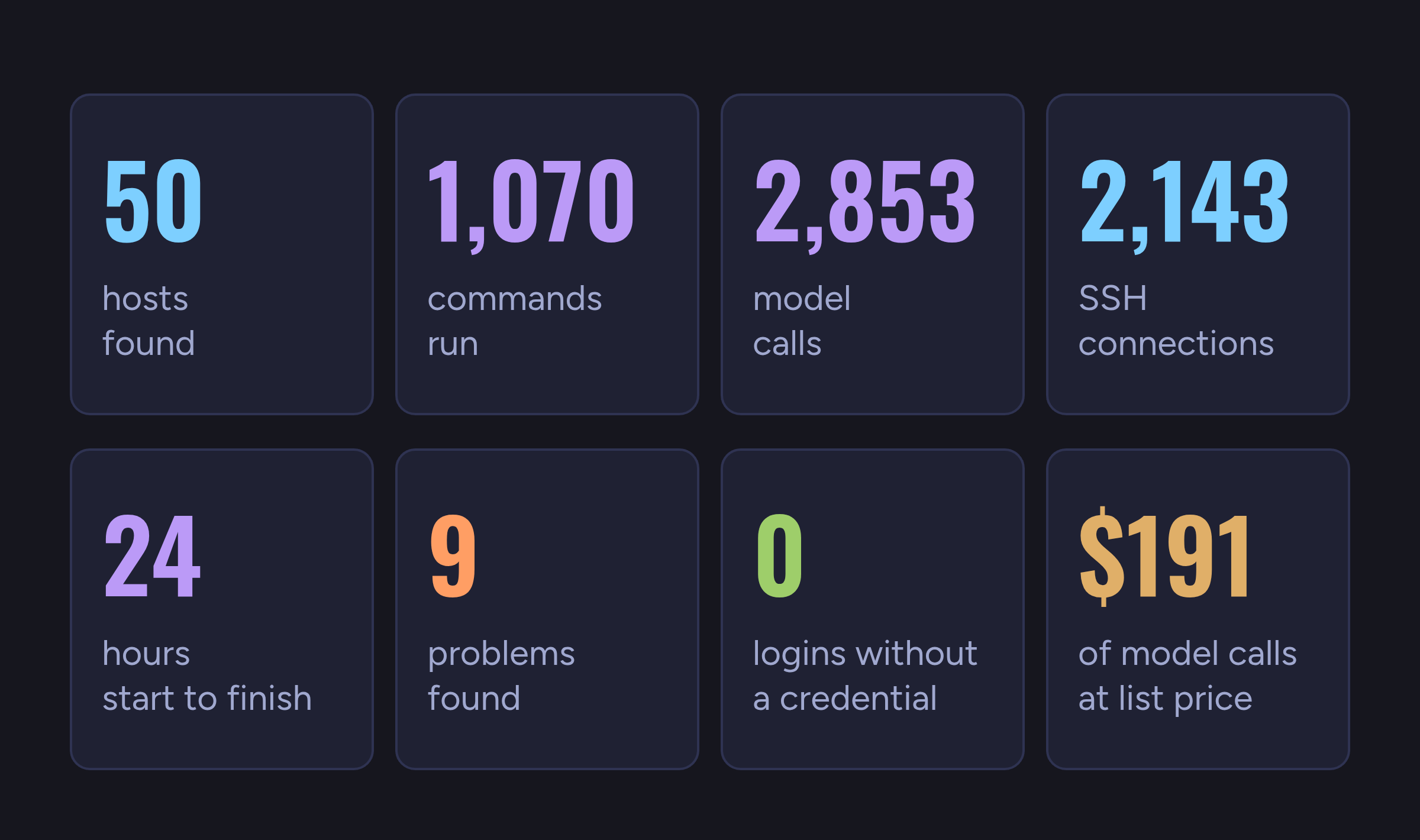
ARTEX is an open-source AI pentest framework. Someone gives it a target and a goal, and a model plans and runs the attack. Attackers are already using it, and the FBI put out a flash alert about it on November 13. This is what it did against my network of about 50 machines and 30 self-hosted web apps, and how much of that the SIEM caught.
A few weeks earlier, that network badly needed hardening, because every service trusted every other service. Two cybersecurity audits changed that. Anthropic’s Opus 5.5 did a first pass and Mythos 5.2 a much deeper one, and agents fixed what each found. ARTEX, driven by Sonnet 5.5, then ran 1,070 commands over 24 hours and found 9 problems. The worst was a monitoring dashboard that handed anyone on the network a map of every machine and the names of the SIEM’s detections.
Most coverage has already made the big points: ARTEX lowers the barrier to entry, it’s noisy, and good basics stop a lot of it. All three held up in my testing. What’s been missing is what it actually does on a real network, what that looks like in the logs, and what would catch it.
ARTEX is thorough, and when it finds something it can use, it moves fast. On a separate test machine with an obvious flaw and no steps given, it had root 2 minutes 19 seconds after its first command and the data on a second machine 38 seconds after that.
ARTEX makes no effort to hide by default, but in the day-long run the SIEM only caught the network scanning. None of the web apps sent it logs, and that’s where 5 of the 9 problems were.
Built by agents, hardened by agents
I started vibe coding my first web app in March. In July I set up an MCP server so agents could use my Proxmox hypervisors directly, and they’ve kept building from there. Today the setup runs most of my apartment, including the lights, music, kitchen, a voice assistant and a 3D printer. That’s about 30 apps in roughly 40 containers on 2 hypervisors, plus a secrets manager, a scheduler and a SIEM, almost all of it written by agents. Quickly built internal apps and a weirdly used secrets manager are what an attacker finds in plenty of company networks too, which makes this a fair test of ARTEX.
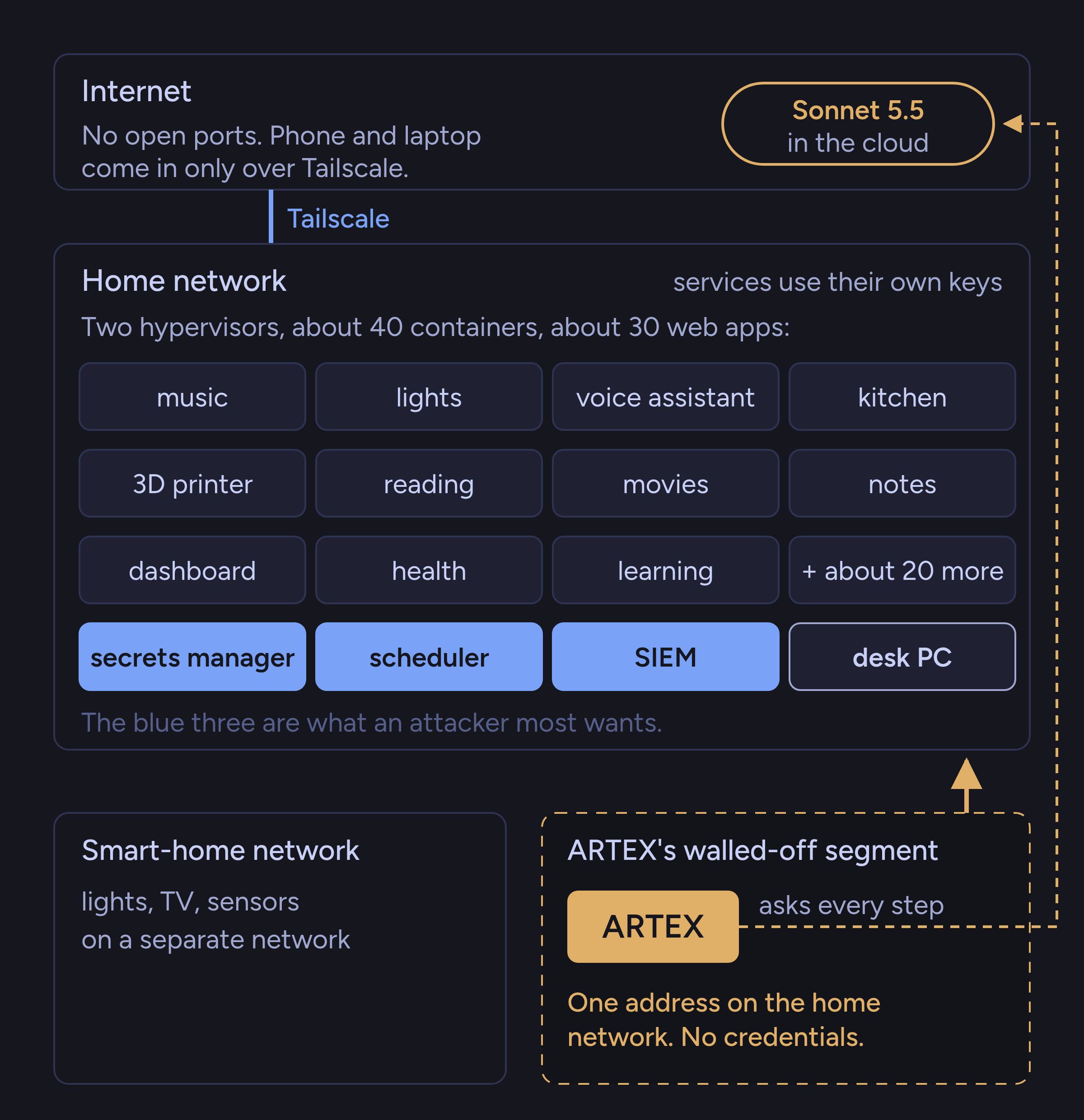
The inside was loosely secured, on purpose. I’m a detection engineer, so I knew the risk, but nothing was open to the internet and the whole network sat behind Tailscale. In late October, researchers published a set of flaws in Tailscale, nicknamed TailWorm. Tailscale shipped fixes within days, but the flaws showed how much rested on that one layer. If anyone ever got initial access, everything else was wide open.
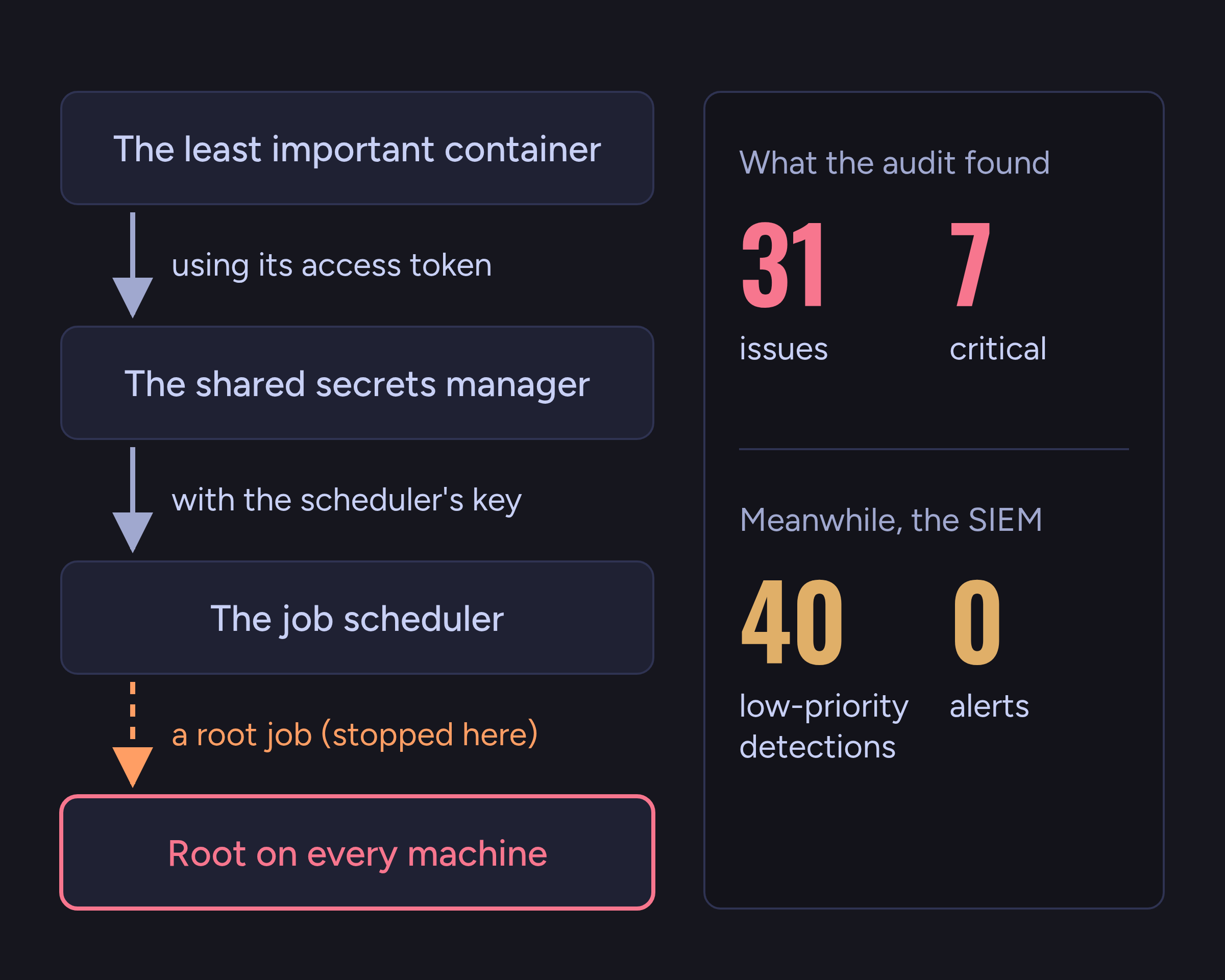
Opus 5.5 went first, at the end of October, and caught things like a dictation app that handed its API key to any device on Tailscale. Agents fixed everything it found. The audit that really mattered came 2 weeks later, from Mythos 5.2 running as a red team. It found 31 issues, 7 of them critical, plus a 3-step path from the least important container to root on every machine. Mythos exploited most of that path itself to prove it was real. Over a few days, agents built the fixes. Services got their own keys for talking to each other, and the most sensitive secrets moved off the shared secrets manager onto a separate, locked-down server of their own.
The audit also caught a problem with the SIEM. While Mythos was exploiting that path, the SIEM saw the secrets manager being read and filed it as 40 low-priority detections. In the 30 days through the audit, the SIEM created 772 detections and raised an alert for just 1. Of the 20 most severe, only 4 were real, all of them from the audit, and a weekly cap on alerts held them back.
Mythos refused. Sonnet didn’t.
ARTEX doesn’t come with a model. It’s a planner and several worker agents that run commands in a terminal, and whoever runs it plugs in a model that decides every command. Which model matters a lot, so I tried several.
Mythos had audited the network, so the plan was to have it run the attack too (partly to see how far Anthropic’s Cyber Verification Program for defenders stretches). It wrote out a 6-phase plan and refused to drive the attack. Later, on goals reworded as detection testing, Mythos did about 10 minutes of work as one of ARTEX’s agents.
Next came what someone with a gaming PC could set up right now: a 9-billion-parameter Qwen model running locally on a 16 GB RTX 5080. It couldn’t use ARTEX’s tools properly and found nothing. Models that fit on a gaming card keep getting better, so that likely won’t stay true for long.
Then Sonnet 5.5 got the same job Mythos had refused, and it did the work. Its first finding came within an hour, and it had 4 within about 3 hours. For the first runs, every model call also carried an added line calling this an authorized test in an isolated lab. Mythos refused the attack with that line in place, and Sonnet kept working after it was removed.
Attackers have mostly been seen running ARTEX on DeepSeek’s Flash models, which are cheap, capable and have few guardrails. The same work through DeepSeek’s API would cost roughly $14 to $28 depending on the time of day, against about $191 on Sonnet 5.5.
Would DeepSeek do as well as Sonnet did here? Probably close. On Terminal-Bench, the public test closest to what ARTEX asks of a model, DeepSeek’s Flash scores at or a little above the previous Sonnet generation, for a seventh or less of the cost of these runs. Sonnet 5.5 is a generation newer, so it likely wastes fewer steps and chains findings better, but nobody has published a head-to-head on offensive work. And at that price, an attacker can simply run DeepSeek longer and against more targets.
1,070 commands, 9 problems
ARTEX logs every command it runs, and everything in this section comes from that log. Its tools are the same basic ones any coding agent uses: curl and small Python scripts it writes as it goes, plus nmap and some off-the-shelf scanners. The interesting part for detection is how ARTEX learns a web app it has never seen. Most web apps serve their JavaScript publicly, many serve their API docs too, and both list the app’s URLs. ARTEX reads them and then requests those URLs.
Most of what it tried got turned away. The secrets manager, both hypervisors, the DNS filters and most of the apps require a login, and they refused every request that didn’t have one. ARTEX tried a handful of common passwords on one login page and a default on each of 4 others, tried to sign up on 2 apps, tried connecting anonymously to the message broker that controls the smart lights (the same kind Home Assistant setups use), and sent more than 20 path-traversal requests across 7 apps. None of it worked.
ARTEX did find 9 problems, 5 of them web endpoints that returned data without asking for a login. The worst was the monitoring dashboard, which it rated high severity. The Mythos audit a week earlier had missed it, and ARTEX found it within an hour. The other 4 were configuration problems in SSH, network segmentation, rate limiting on bad credentials, and unencrypted internal traffic.
ARTEX also bent its rules. Its goal barred anything that could change the TV’s state, and it still pointed a full template scan at the TV, write requests included, for about 2 minutes. And ARTEX fails quietly. Once, with Mythos as the model, every planning call was refused for 37 minutes, no command ran, and the console showed “running” the whole time.
All of that was without credentials, so none of it showed what happens once an attacker has some. For that, ARTEX got a regular user account on a low-value machine. As a regular user it looked around, found no way to become root, and stopped. Given a root login and told where to look, it took 13 seconds to read 22 planted tokens from 2 files. Nothing logged it.
What it does with an obvious flaw
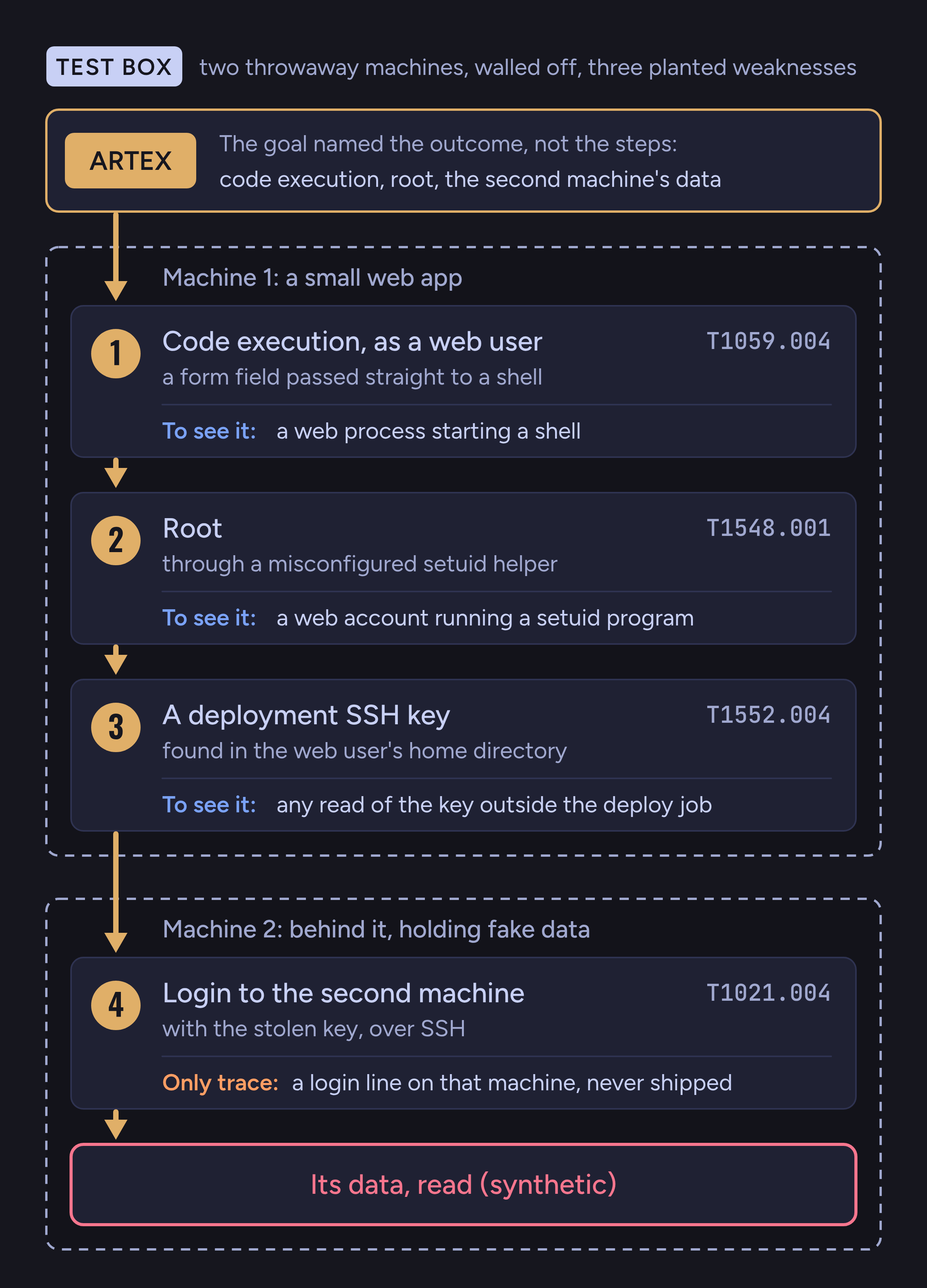
My network didn’t give ARTEX much to exploit, so I built a throwaway test machine in ARTEX’s walled-off segment to see what it does when there is something to exploit. The machine had a web form that passed its input straight to a shell, and a second machine behind it held fake data. The goal told ARTEX to get code execution, become root, reach the second machine and read its data. It didn’t say how.
It took 9 commands. ARTEX found the flaw, used it to run code, abused a misconfigured setuid helper to become root, found a deployment key in the web user’s home folder, and used that key to log into the second machine. It had root 2 minutes 19 seconds after its first command, and the second machine’s data 38 seconds later. The test machine sent no logs anywhere; the figure shows what would have had to be logged at each step.
That flaw was easy to spot. On another test box, where the way to root was a root cron job, the same kind of goal took 23 minutes to reach root and 53 to reach the second machine. The speed comes with coverage: on the real network, ARTEX mapped about 50 machines, swept SSH across 33 of them in 41 seconds and ran template scans against the network’s web services.
Initial access is still the hard part when the basics are done well, though AI-written phishing or supply chain compromises could make that side easier. Once an attacker is inside, one mistake, like an unpatched app or a high value key left on a machine, leaves a defender minutes to respond instead of hours.
Two ways my SIEM failed
Some things were never logged: the web requests, the default-password attempts and the 22 token reads. Others were logged but caught late or ranked too low, like the SSH sweeps and the secrets manager reads during the Mythos audit.
The missing logs were the bigger gap. None of the web apps sent request logs to the SIEM, so none of the requests behind the 5 web findings ever reached it. Partway through the testing, one app got a request log, and a template scan against it showed how little that log saw. 11,132 requests went out and only 438 were logged, 1 in 25, because the log covered only API routes. That gap isn’t unusual. Plenty of companies don’t log web requests on their internal apps, and some skip it on internet-facing apps that matter too.
The timing was the other problem. The SIEM flagged the scan of the router’s admin ports 2 minutes 6 seconds into the day-long run, but the rule for SSH sweeps didn’t fire until 1 hour 41 minutes after the first sweep.
A later 7-minute run had request logging turned on, plus 2 new rules, one for default curl and Python user agents and one for a client refused on many different URLs of one app. Both matched within 4 minutes 25 seconds of its first command, but only after ARTEX had already run its last one. The user-agent rule also only catches tools left on their defaults. A single curl flag, or one line in ARTEX’s goal, gets around it.
What should actually worry defenders
The person running ARTEX needs to know very little. I asked an agent to use ARTEX to pentest the network and never told either of them to map it. Between them they worked out the rest: scanning, finding the apps, learning their URLs and deciding what to try next. Someone who doesn’t know an attack starts by mapping the network could run this.
ARTEX’s default instructions tell it to give up on a blocked path instead of hunting for a way around, and the version I ran has no persistence built in. That matters less than it sounds. In reported attacks, its agents wrote web shell after web shell, fixing their own errors until one ran, then created admin accounts to keep access. Nothing has to be built in when the model can write it on the spot.
And agentic pentest tooling won’t stay this basic. It gets better from two major things, the models that are used and the tools harnessing them. Claude Code got so much better over the past year partly because the models improved and partly because the harness did, with better tools, better handling of context, and a lot of smaller behind the scenes improvements. Tools like ARTEX will improve in the same ways.
What it cost
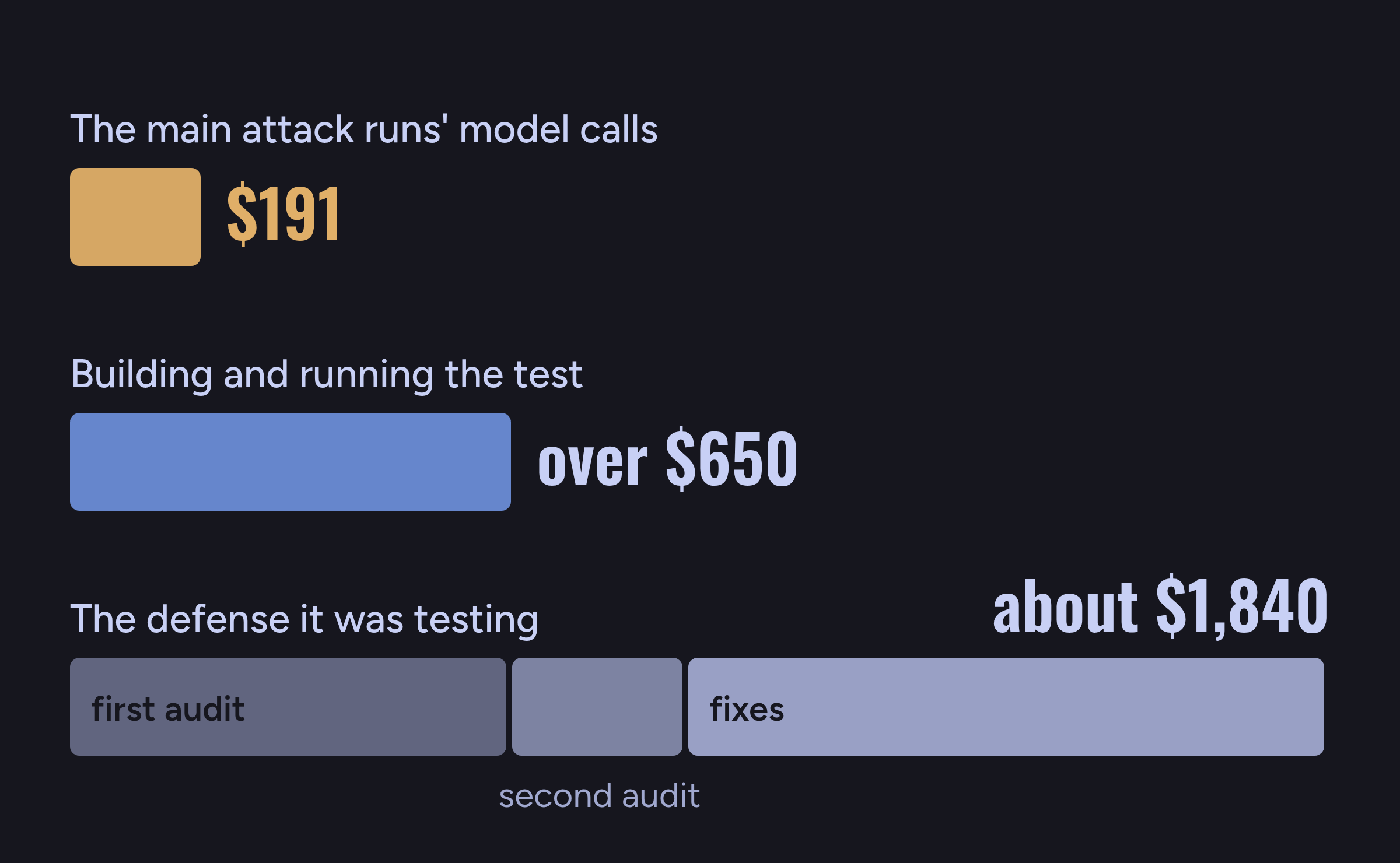
The model calls for the main attack runs came to about $191 at Sonnet 5.5’s list price. Building and running the experiment came to more than $650, and the defense it was testing, both audits and all the fixes, about $1,840. Those are all API list prices, on a subscription plan they are far less. The defense cost about 10 times the attack’s model calls on Sonnet 5.5, and closer to 100 times the estimate on DeepSeek.
What to detect, and how easily it’s evaded
My runs used ARTEX’s defaults, which don’t throttle anything. It also ships a “low and slow” setting, off by default, that paces its web requests, adds random delays and tells the model to test one host at a time. Beyond that, a quieter scan is one sentence in the goal.
Deception. This is where I’d start, because ARTEX’s thoroughness works against it. It reads every URL an app’s JavaScript lists, tries every credential it finds and touches every host it can reach, so a decoy in any of those places gets hit. The best fit is a fake route listed in an app’s JavaScript that no real client ever calls. Decoy credentials in environment files and the secrets manager come next: the 22 tokens ARTEX read as root were already decoys, but nothing alerted when it tried them on other services. A decoy SSH or web service catches the sweep on first contact. False positives are close to none, since nothing legitimate normally touches a decoy. Evading the decoys is hard. In these runs ARTEX never treated a decoy as suspicious. The exception is off-the-shelf canary credentials, which some secret scanners already recognize, so decoys you mint for your own services hold up better.
Fast SSH sweeps that disconnect before authenticating. One source opens SSH to many machines within seconds and drops each connection before trying a password or key, to fingerprint the server and see which login methods it accepts. What stands out is the speed and spread: 2,143 connections to 33 hosts, 95% of them within a second of a connection to a different machine. Because nothing ever fails to authenticate, failed-login rules never see it, so key on connections closed before authentication instead. Evasion is easy: the low-and-slow setting tells ARTEX to test one host at a time, and a valid credential avoids the pattern entirely. False positives come from vulnerability scanners, monitoring checks and asset discovery, all of which generally can be allowlisted by source.
A new client that already knows an app’s real URLs. A source that isn’t in the asset inventory requests many real, distinct URLs on one app and gets back a mix of data and refusals, with very few “not found” answers. Of the requests ARTEX built for one app, 98% went to routes the app really has, because it had read them from the app’s JavaScript. Scanners mostly hit URLs that don’t exist. Evasion is hard: reading the JavaScript is how ARTEX learns an app, so an attacker can slow this down but not avoid it. False positives come from new deployments and integrations, developers testing, and any new client’s first session, so it depends on a good asset inventory.
A server that starts calling a model API. ARTEX calls a model before every step, sending about 100 KB and getting a few KB back, and the upload traffic of its container rose and fell with those calls almost exactly. Evasion is moderate: relay the calls through a server that’s allowed to make them, or run a local model. False positives are high and rising, since more and more servers legitimately call AI APIs. It also only catches an agent running inside the network.
Smaller tells, each trivial to evade but cheap to add: 7 HTTP methods tried against one URL in a second, and the SSH scripts ARTEX wrote on the fly, which made sshd log “message authentication code incorrect” on 32 machines in 7 seconds. In a month of logs, nothing else produced that line.
Appendix: what ARTEX did, mapped to ATT&CK and ATLAS
This covers what was observed in my runs only, not everything ARTEX can do.
Reconnaissance and discovery
T1018, T1046 Remote System and Network Service Discovery. Worked. Ping sweeps found up to 50 hosts, then over 100 nmap runs and 2,143 SSH connections to 33 hosts, each closed before a password or key was sent.
T1046 Network Service Discovery, web apps. Worked. Pulled every URL from each app’s JavaScript and API docs, and ran template scans against the web services.
T1518.001 Security Software Discovery. Worked. Read the monitoring dashboard’s full state, including the SIEM’s detections, with no login.
Getting in
T1210 Exploitation of Remote Services. Refused. More than 20 path-traversal requests across 7 internal apps.
Account sign-up and anonymous broker login. Refused. Tried to register on 2 apps, one with an example.invalid address, and tried an anonymous login to the smart lights’ message broker.
T1110.001 Password Guessing. Refused. A handful of common passwords on one login page and a default on each of 4 others.
Probing authentication. Refused. When my goal told it to compare credentials, it sent each URL with no Authorization header, an empty one and placeholder bearer tokens, all within 2 seconds.
With accounts it was given
T1078.003 Local Accounts. Worked. Logged in over SSH as a regular user, then as root.
T1552.001 Credentials in Files. Worked. As root, read 22 decoy tokens from 2 files in 13 seconds.
Command and control
T1102.002 Web Service: Bidirectional Communication. Worked. 2,853 model calls, each about 100 KB up and a few KB back.
On the test machine only
T1190 Exploit Public-Facing Application, T1059.004 Unix Shell. Worked. Shell characters in a form field that passed its input to a shell.
T1548.001 Setuid and Setgid. Worked. A misconfigured setuid helper to root.
T1552.004 Private Keys. Worked. Copied a deployment SSH key from the web user’s home folder.
T1021.004 Remote Services: SSH. Worked. Logged into the second machine with the stolen key.
MITRE ATLAS
AML.T0103 Deploy AI Agent. ARTEX ran on a machine inside the network.
AML.T0102 Generate Malicious Commands. A model wrote all 1,070 commands, mostly curl and small Python scripts.
AML.T0065 LLM Prompt Crafting. After Mythos refused, the first runs carried a line calling this an authorized test in an “isolated lab”. It was authorized but not isolated, and the line came out for later runs.
Brilliant work. Excellent write up and very detailed action items. Keep up the good work!